One Motion Reliability
What 990 Units, 42 Plants, and Six Years of Poultry Washdown Taught Us About Reliability
A field-data analysis from the largest end-user of One Motion Direct Drive Rotary Motion technology.
The Question Every Plant Manager Eventually Asks
In food manufacturing, reliability is not a marketing claim. It is a line item on the maintenance budget, a scheduled outage on the production calendar, and a phone call at 2 a.m. when something fails in the middle of a production shift.
For decades, the drive technology that moves products through a poultry plant has been treated as consumable. Motors and gearboxes get specified, installed, run for two shifts a day, and subjected every night to a full caustic-and-acid cleaning cycle, then replaced on a schedule that everyone in the industry has quietly accepted as the cost of doing business.
We wanted to know if that cost was still necessary.
So we went to the customer with the largest installed base of One Motion Direct Drive Rotary Motion (DDRM) units in the world, pulled the numbers, and let the field data speak for itself.
📊 The Dataset at a Glance
• 990 DDRM units in active production
• 42 production sites across North America
• 101 unique part numbers specified across the fleet
• Continuous service since early 2020 — six years of poultry duty
This is not a pilot deployment, a test cell, or a single line. It is a fleet, distributed across a real production network, doing real work in the harshest hygienic environment in food manufacturing.
Why Poultry Is the Hardest Test
Poultry processing punishes equipment in ways that few other food categories do, and the reason is in the daily cycle.
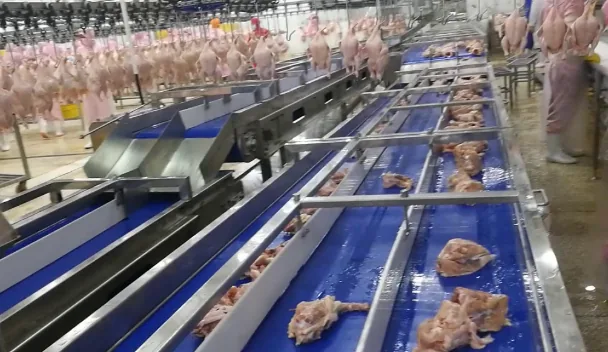
A typical poultry plant runs two production shifts per day, with the third shift dedicated to intense cleaning. That cleaning shift is not a rest period for the equipment. It is the most aggressive eight hours of every twenty-four. Caustic foam is applied at high pressure and elevated temperature, followed by acid sanitizer, followed by rinse. Fat, protein, and chlorinated chemistry attack seals, bearings, and electrical connections from every angle.
Production itself is not a neutral environment either. Ready-to-eat (RTE) areas, including packaging and post-lethality handling zones, are held at cool room temperatures throughout the shift to suppress pathogen growth and protect product safety. That means a drive in an RTE zone is not just surviving a hot wash and a cold rinse once a day. It is running production cold, getting hit with a hot caustic wash, dropping back into a cold rinse, and then being asked to come back up to operating condition in a chilled ambient. Anyone who has spent time on an RTE floor knows the tell. When your hands are cold, you can walk up to a conventional motor and warm them on the housing. That warmth is wasted energy, and it is also a thermal signal. Every degree the motor is throwing off into a cold room is a degree that has to cycle back down during washdown, pulling moisture and chemistry toward the seals as the housing contracts. The plant’s food safety requirements and the drive’s mechanical reality are pulling in opposite directions, every single day.
What makes this duty so hard is not the runtime. It is the cycling. Every day, the drive goes from full operating load and temperature, into a hot chemical wash, into a cold rinse, into a dry-down, and back up to operating temperature for the next production shift. Thermal cycling, wet-dry chemistry cycling, and the pressure differential between hot operation and cold rinse all conspire to push moisture, chemistry, and stress past the seals of any drive not architected for this environment.
Conventional drive technology was not designed for this cycle. It was adapted to it, with stainless housings, IP69K ratings, and special seal arrangements bolted onto architectures that originated in dry, ambient industrial duty. The result has been a maintenance treadmill that the industry has normalized.
The deeper issue is that conventional motor architecture is designed to run hot. Even when a plant oversizes the motor, putting a larger, more powerful unit on a light load, the motor still runs hot, because the base design assumes heat as a normal byproduct of operation. That heat is managed in standard industrial environments by a cooling fan on the back of the motor and radiation fins along the housing. Move that same motor into a hygienic environment and those features have to come off. The fan becomes a contamination risk and a cleaning problem, and the fins become harborage points for product residue and bacteria. Strip them away to meet sanitary requirements and the motor loses the very features it was designed around to shed heat. The hygienic version of a conventional motor is, by definition, a motor running hotter than it was ever meant to, inside a stainless shell, inside a cold room, getting washed down every day. The architecture is fighting itself.
The Headline Number
The customer told us, plainly, that they purchase approximately 200 DDRM units per year as replenishment against their installed base of 990.
That is a steady-state replacement rate. It is the rhythm of a fleet that has matured, found its operating envelope, and settled into a predictable cadence. It is also the cleanest possible signal of average service life.
Average Service Life = Installed Base ÷ Annual Replacements = 990 ÷ 200 ≈ 5 years
Five years of average service life in the poultry two-shift production, one-shift sanitation cycle.
This is the steady-state turnover method, the same approach used in industrial reliability studies and Department of Energy fleet analyses when individual failure timestamps are not available. As long as the fleet size is stable, which this one has been since 2020, the math is robust.
It is also worth being upfront about what is included in that 200 units per year. It is everything: mechanical end-of-life, impact damage from forklifts and sanitation crews, application changes from line reconfigurations, and preventive swap-outs during major plant turnarounds. The pure mechanical failure number would be better than five years, not worse. That is the strength of the claim, not a weakness.
🔁 The 1-2-3 Cycle, Multiplied Out
Two shifts of production. One shift of intense cleaning. Repeated day after day.
Over a five-year service life, the math is sobering:
5 years × 365 days = 1,825 daily cycles
That is 1,825 cycles of full thermal, chemical, and pressure stress that every average DDRM unit in this customer fleet survives before it is replaced. Not rebuilt. Not recorded. Not remanufactured. Replaced — at the end of its natural service life — with a new unit, and the next 1,825-cycle clock starts.
The Comparison That Matters
When a plant engineer is specifying a new line, they are not choosing between One Motion and a strawman. They are choosing between three real options.
Option 1: Stainless-Steel Premium Washdown Motor and Gearbox
This is the conventional architecture done right. A stainless TENV motor from a serious supplier paired with a stainless reduction gearbox. Brands like Stober Clean, SEW SS, and Baldor stainless TENV represent the top tier of what the conventional motor and gearbox industry can offer for hygienic duty.
In poultry, even these premium packages typically need to be replaced every 12 months. The daily wash chemistry, thermal cycling, and the cumulative seal stress wear the system out within a single year of service. The customer absorbs a full fleet replacement cost annually.
Option 2: Drum Motors
Drum motors are the closest functional competitor to DDRM. Both are integrated; motor-inside-the-pulley designs purpose-built for washdown. The difference is the architecture inside.
Drum motors carry a manufacturer-recommended rebuild interval of 18 months to 2 years. The unit is removed from the line, returned to the OEM or an authorized rebuilder, stripped down, refitted with new bearings, seals, and gear sets, and reinstalled. The motor and electronics carry residual wear into the next service cycle, which is why subsequent rebuild intervals often run shorter than the first.
And rebuilds are not indefinite. Industry practice is to retire a drum motor after two rebuilds. The customer’s lifecycle is therefore three service events spread across roughly four and a half to six years: the initial install, the first rebuild, the second rebuild, and then a full replacement. Over the same period that One Motion DDRM delivers five years of service from a single install, a drum motor fleet has been touched by three return-to-OEM events per unit.
A rebuilding is not free. It carries a service fee, weeks of turnaround time, labor on both ends, and the carrying cost of spare units in inventory to cover the gap. Multiplied across a fleet, the rebuild tax becomes a permanent feature of the maintenance budget — and at the end of the rebuild cycle, the customer is back to buying a new unit anyway.
Option 3: One Motion DDRM
The architecture is different from the inside out. The motor is a direct drive. There is no gearbox to wear out, no separate seal interface between motor and reduction; no rebuild cycle baked into the maintenance plan. When a unit eventually reaches the end of life, it is swapped out, not sent back.
The field data from this customer says that the average DDRM unit lasts roughly five years — 1,825 daily wash cycles — in poultry duty.
The Side-by-Side
| Drive technology | Service interval in poultry duty | Annual service burden on a 990-unit fleet |
|---|---|---|
| Stainless-steel premium motor + gearbox | ~1 year (replace) | ~990 service events |
| Drum motors | 18 months to 2 years (rebuild) | ~495 to 660 service events |
| One Motion DDRM | ~5 years (replace) | ~200 service events |
Even at the most generous assumption for drum motors, the maintenance manager running a DDRM fleet is dealing with roughly two and a half times fewer service events per year than they would on drum motors, and nearly five times fewer than on a stainless premium motor and gearbox fleet.
The Full Lifecycle Picture
Annual service burden tells part of the story. The full picture emerges when you follow a single drum motor from cradle to grave.Li
| Lifecycle path | Total service events | Years to reach final replacement |
|---|---|---|
| Drum motors (install + 2 rebuilds + replacement) | 3 service events | 4.5 to 6 years |
| One Motion DDRM (install only) | 1 service event | 5 years |
The two technologies reach a comparable end-of-life horizon. The difference is in what it costs to get there. A drum motor fleet is touched by three return-to-OEM service events per unit before final replacement. A DDRM fleet is touched by zero. The customer pays for the rebuilds, the labor, the turnaround time, and the spares inventory required to cover them — and then buys a new unit anyway. DDRM compresses that entire lifecycle into a single install.
The Multipliers
**DDRM vs. stainless premium =****5 years ÷ 1 year =**5× service life
DDRM vs. drum motor = 5 years ÷ 1.5 to 2 years = 2.5× to 3.3× interval between service events
And the DDRM number is the replacement cadence, not a rebuild cadence. There is no return-to-OEM step, no rebuild fee, no aging core. A unit installed in 2020 that runs until 2025 is simply swapped for a new one, and the next five-year clock starts.
What the Fleet Looks Like Under the Hood
The 990-unit installation is not concentrated in one plant or one application. It is distributed and varied:
· Top 5 sites account for roughly half of the fleet, with the largest single plant running 221 DDRM units across 27 different part numbers. That site alone is one of the deepest single-customer references in industrial direct drive technology.
· Top 10 sites account for roughly 70 percent of the fleet.
· The remaining 32 sites carry the balance, often in smaller deployments where DDRM was specified into a specific line rather than rolled out plant wide.
A small number of part numbers do the heavy lifting. The single most-deployed SKU appears at 11 of the 42 sites and accounts for more than 6 percent of the entire fleet. This is what platform standardization looks like in the field: a customer with thousands of square feet of conveyor and dozens of plants converging on a small set of proven SKUs.
What Five Years of Life Actually Buys the Customer
The reliability number is not just a maintenance metric. It is a business outcome.
· Lower scheduled downtime. Fewer service events per year, distributed across a 990-unit fleet, means fewer planned interruptions, fewer line stops for swap-outs, and fewer rebuild cycles to coordinate around the sanitation shift.
· Lower spares inventory carrying costs. When the annual replacement rate is 20 percent instead of 50 to 100 percent, the spares cabinet does not need to be sized to cover a continuous rebuild churn.
· Lower service logistics. Replacement is local and immediate. There is no return-to-OEM step, no shipping cycle, no rebuild queue.
· Predictable budgeting. A steady-state replenishment of 200 units per year is a planning number a plant can rely on. A drum motor rebuild schedule with variable intervals and shrinking subsequent service lives is not.
What This Says About the Platform
One Motion did not set out to build a better motor. We set out to build a Direct Drive Rotary Motion platform purpose-engineered for the environments where conventional drive technology has always struggled. The DDRM hardware is the foundation. The CorTex edge intelligence layer and the GUS AI support agent extend the platform into how the technology is monitored, supported, and scaled across a customer’s operation.
Reliability is the proof of concept. A platform that survives 1,825 daily wash cycles of caustic, acid, thermal swing, and pressure differential before reaching an average end of life is not a redesign of the old architecture. It is a different architecture.
⚠️ The Caveats Worth Naming
A serious reliability claim should name its limits. Three are worth stating directly.
The 200 units per year includes everything. It is not a pure mechanical failure rate. It includes damage, application changes, and preventive swaps. The mechanical-only number is better than what we are quoting.
The benchmark comparisons rely on industry-standard service intervals. Stainless premium motor and gearbox life of approximately one year in poultry, drum motor rebuilds intervals of 18 months to 2 years, and the industry practice of retiring drum motors after two rebuilds, are well-established figures in poultry maintenance practice. Individual plants and brands vary. The point is the order of magnitude, not the decimal place.
The data is from one customer. A very large customer, with a 990-unit fleet across 42 sites, but one customer. The reliability story strengthens as more customers reach five or six years of run time with their own deployments, and the early data from other customers is consistent with the trend reported here.
The Number to Remember
Nine hundred and ninety units. Forty-two plants. Six years in the field. Two production shifts and one cleaning shift every day. 1,825 wash cycles per unit before average end of life. Twenty percent annual fleet turnover. Five years of average service life.
In an industry that has accepted annual replacement and 18-month rebuild cycles as the price of admission — and that quietly assumes drum motors will be torn down twice and replaced once over the same five-year window in which One Motion DDRM simply runs — those numbers represent a different equation. They are the result of building the right architecture for the environment, not adapting the wrong architecture to survive in it.
For the customer, the math is a maintenance budget that looks nothing like the one their competitors are running. For the industry, it is a signal that the drive economics of hygienic food manufacturing have been quietly rewritten in the field, one production line at a time.
🔧 About One Motion DDRM
One Motion Direct Drive Rotary Motion technology has been in continuous production deployment since 2014, with more than 20,000 units installed globally across food manufacturing, packaging, and process industries.
To learn more about specifying DDRM in your next conveyor or process design, contact our engineering team.
Found this useful? Share it with your team.