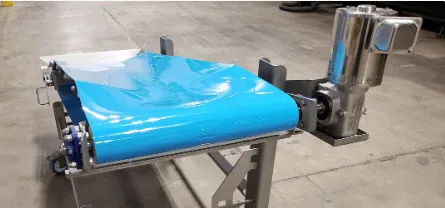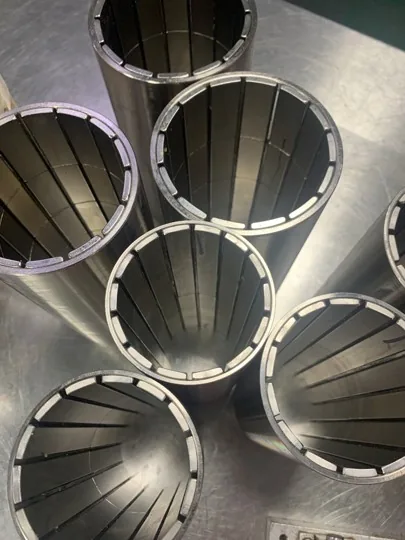
Direct drive is proven technology in aerospace, military, and consumer products. Food manufacturing is the last major industry still dependent on motor+gearbox. One Motion built direct drive specifically for washdown. The mindset change starts with OEMs - and those who move first will own the conversation.
Our Technology:
utilizes high-density magnetic arrays to generate strong and efficient magnetic fields. These fields are applied in outer runner designs to facilitate rotary motion. This technology aims to boost reliability, significantly enhance electrical efficiency, reduce the number of moving components, and improve mechanical system performance. It is specifically engineered for the food manufacturing sector, where these benefits can greatly streamline production operations.
A Revolutionary Change in an Old, Time-Tested Method
Revolutionary change is never easy to accept. Especially when the method being replaced has worked for over a century.
The electric motor paired with a gearbox is one of the most time-tested power transmission systems in industrial history. It has driven conveyors, mixers, pumps, and packaging lines for generations. Engineers trust it. Maintenance teams know it. Supply chains are built around it.
So when someone says there is a better way, the natural response is skepticism.
That skepticism is understandable. But it does not change the physics.
One Motion’s Direct Drive Rotary Motion technology is not an incremental improvement to the motor and gearbox. It is a complete paradigm shift in how rotary motion is delivered in food manufacturing.
Proven Everywhere Else. New to Food.
Direct drive technology is not new to the world. It is the dominant motion technology in industries where performance, precision, and reliability are non-negotiable:
· Aerospace (satellite reaction wheels, flight control actuators)
· Military and defense (weapons systems, autonomous platforms)
· Medical devices (MRI systems, surgical robotics)
· Consumer products (washing machines, HVAC fans, electric vehicles)
· Robotics and semiconductor manufacturing
In these industries, direct drive replaced geared systems decades ago because it delivers higher reliability, lower maintenance, and better efficiency.
Food manufacturing is one of the last major industries still relying almost entirely on motor-plus-gearbox architectures for rotary motion. That is not because food plants do not need the same benefits. It is because no one had engineered a direct drive system specifically for the hygienic demands of food production.
Until now.
Why Food Manufacturing Is Different
The reason food manufacturing has been slower to adopt direct drive is not resistance to innovation. It is the environment itself.
Food plants require:
· Daily high-pressure washdown with caustic and acidic chemicals
· IP69K-level sealing against water ingress at extreme pressures
· Surfaces that can be fully sanitized to eliminate biologically active material
· Equipment that operates reliably under constant moisture, thermal shock, and chemical exposure
These requirements make food manufacturing one of the harshest operating environments for any electromechanical system. Most direct drive solutions designed for aerospace or consumer applications would not survive a single sanitation cycle in a poultry or protein plant.
One Motion was engineered from the ground up for this exact environment. Every design decision, from the sealed outer-runner housing to the oil-free magnetic architecture, was made with daily washdown as the baseline assumption, not an afterthought.
Where the Mindset Change Has to Happen
In food manufacturing, the end user (the food producer) ultimately receives the benefits of direct drive technology:
· Less downtime from motor and gearbox failures
· Improved food safety through easier-to-clean, oil-free equipment
· Lower energy costs from higher electrical efficiency
· Reduced maintenance labor and spare parts inventory
But the end user does not design the equipment. The original equipment manufacturer (OEM) does.
This is where the mindset change has to occur.
For decades, OEMs have designed conveyors, processing machines, and packaging systems around the assumption that a motor and gearbox is the only way to deliver rotary motion. Engineering teams specify gearboxes by reflex. CAD libraries are built around standard motor frames. Procurement systems are optimized for gearbox vendors.
Adopting One Motion means rethinking that foundation:
· Designing without a gearbox changes the mechanical envelope
· Eliminating oil changes the sanitation profile of the entire machine
· Reducing moving parts changes the maintenance conversation with customers
· Improving efficiency changes the energy and sustainability story
This is not a component swap. It is a design philosophy change.
And it is exactly the kind of change that separates OEMs who lead their market from those who follow.
The Opportunity for OEMs Who Move First
OEMs who adopt direct drive technology gain a competitive advantage that is difficult to replicate quickly:
· Differentiated machines that deliver measurably better uptime
· Simplified maintenance programs that reduce total cost of ownership for customers
· Cleaner, oil-free designs that align with tightening food safety regulations
· Energy-efficient systems that support sustainability commitments
· A warranty-backed reliability story (three-year standard) that competitors cannot match with conventional drivetrains
The food producers who buy these machines will notice the difference in the first year. Fewer service calls. Fewer rebuilds. Fewer contamination risks. Lower energy bills.
The OEMs who build these machines will own that conversation.
Revolutionary change does not ask for permission. It proves itself in the field. One Motion’s direct drive technology has done exactly that, across nearly 20,000 units in heavy washdown food manufacturing environments worldwide.
In food manufacturing, reliability is talked about constantly. But it’s often discussed in the wrong environment.
Bench tests. Clean rooms. Ideal conditions. Numbers that look good on paper but fall apart on the plant floor.
If reliability isn’t proven in heavy washdown, it isn’t proven at all.
Where Reliability Actually Gets Tested
Every One Motion product operates in the same environment:
· Daily high-pressure washdown
· Aggressive sanitation chemicals
· Strict food-safety protocols designed to eliminate biologically active material
This is IP69K duty. It is intentionally hostile to machinery.
Anyone who has worked in protein, poultry, bakery, produce, or ready-to-eat plants knows the outcome for traditional systems:
· Seals degrade
· Bearings contaminate
· Oil becomes a liability
· Gearboxes wear, leak, or fail
In many food plants, one year of service life is considered normal for conventional motor and gearbox systems. Spares are stocked. Rebuilds are planned. Downtime is expected.
That reality sets the baseline.
Reliable compared to what, and where?
Simple Motion Survives Where Complexity Fails
One Motion products are built on a single architectural decision:
Direct Drive Rotary Motion.
That decision removes failure mechanisms instead of managing them.
No gearboxes. No oil. No lubrication systems. No cascading seals and interfaces.
What remains is a simpler system with fewer components exposed to washdown pressure, chemicals, and thermal cycling.
In washdown environments, complexity fails first. Simplicity lasts longer.
But simplicity is not the absence of engineering. It is the result of deeper engineering.
What follows is the electromagnetic design that makes Direct Drive Rotary Motion possible and explains why it delivers reliability where food is made.
The High-Density Magnetic Design Behind One Motion Reliability
Outer-Runner Architecture: Torque Starts with Geometry
One Motion products are designed around an outer-runner Permanent Magnet Synchronous Motor (PMSM). In this architecture, the rotor is located on the outside of the stator. Permanent magnets are bonded to the inner surface of a rotating outer shell, while the stator coils remain fixed at the center.
This is a deliberate inversion of conventional motor design. In a traditional inner-runner motor, the rotor spins inside the stator. In One Motion’s outer-runner, the entire outer shell rotates. The result is a fundamentally different relationship between geometry and torque.
On an outrunner motor, the rotor is located on the outside of the stator. Outrunner motors produce more torque for the same build volume compared to inrunner motors. Electromagnetic field lines pass from rotor to stator over a larger surface area. More electromechanical force is generated leading to higher torque levels, especially at low speed.
Why Outer-Runner Geometry Creates More Torque
Torque in any electric motor is the product of force and radius. In an outer-runner, the permanent magnets sit at the maximum possible radius within the motor envelope. This means:
· The air gap surface area between rotor and stator is larger
· The torque arm (distance from center to the point where magnetic force acts) is longer
· More electromagnetic force is generated per unit of electrical input
This is why One Motion can produce torques that would normally require a gearbox. A SideDrive unit delivers 40 Nm continuous and 120 Nm peak torque, equivalent to a 1 HP motor with a 30:1 gearbox, but in a single direct-drive package. A larger 600 mm diameter Powered Hub prototype achieved over 400 Nm using a 112-pole outer-runner design.
In conventional inner-runner motors, lower native torque is compensated by adding gearboxes, belts, or chains. One Motion’s geometry eliminates that need entirely.
High Pole Count: Each Magnet Is a Magnetic Pole
One Motion uses a large quantity of high-energy rare-earth permanent magnets arranged into dense magnetic arrays. Each individual magnet functions as a magnetic pole.
Across the product range, pole counts span from 14 poles to 64 poles in production units, and up to 112 poles in specialized applications.
Diameter
Poles
Slots
120 mm
14
12
135 mm
28
24
215 mm
40
36
406 mm
64
60
High pole count matters for three reasons.
Magnetic density equals energy density.
More poles in the same circumference means more magnetic interactions per revolution. One Motion’s internal materials state: “Magnetic Density = Energy Density = High Mechanical Power.”
Shaped magnets improve efficiency.
The magnets are shaped to optimize the flux path between rotor and stator: “Shaped Magnets = Energy Efficiency = Low Electrical Power Consumption.”
High pole count enables low-speed, high-torque operation.
Unlike conventional motors that spin fast and gear down, One Motion drives operate at low synchronous speeds natively. A 14-pole motor at 4 Hz runs at approximately 34 RPM. This is why One Motion products achieve servo-like precision without servo drives or encoders in many applications.
One Transfer of Energy: The Thermodynamic Advantage
One Transfer of Energy. Direct transfer of electrical power to mechanical rotation. Watts to torque. No wasted energy moving through mechanical gears.
This is grounded in the Second Law of Thermodynamics: “In the process of energy transfer, some energy will dissipate as heat.”
Every additional stage of mechanical conversion (gears, belts, chains, couplings) introduces another point where energy is lost as heat, friction, and noise. One Motion eliminates all intermediate stages. The magnetic field in the stator directly rotates the outer shell. There is no second or third conversion step.
Typical overall efficiency jumps from approximately 60% in a motor and gear system to around 90% with One Motion’s permanent-magnet outer-runner, even at low speeds.
Understanding Lq vs Ld: Why Magnetic Saliency Matters
In permanent magnet synchronous motors, torque is produced through two mechanisms:
Magnetic torque
arises from the interaction between the stator’s rotating magnetic field and the permanent magnets on the rotor. This is the primary torque source in all PM motors.
Reluctance torque
arises from differences in the magnetic reluctance (resistance to magnetic flux) along two perpendicular axes of the rotor:
· Ld (direct-axis inductance): aligned with the permanent magnet poles
· Lq (quadrature-axis inductance): perpendicular to the magnet poles
When Lq and Ld are different, the rotor exhibits magnetic saliency, and the motor produces reluctance torque in addition to magnetic torque.
The total torque equation for a PMSM is: T = (3/2) P [ Φm Iq + (Ld − Lq) Id Iq ]
The first term is magnetic torque (from the magnets). The second term is reluctance torque (from the Ld/Lq difference).
A motor with Lq approximately equal to Ld (no saliency) produces only magnetic torque. A motor with Lq significantly different from Ld produces both magnetic torque and reluctance torque, achieving more total torque for the same current.
Rockwell Automation PowerFlex documentation confirms: “iPM motors have Lq ≠ Ld inductance differences (saliency effect). This characteristic creates reluctance torque that sPM motors do not. To produce the best efficiency, MTPA [Maximum Torque Per Ampere] is on to control reluctance.”
How One Motion’s Design Creates a High Lq/Ld Difference
One Motion uses Surface Permanent Magnet outer-runner designs. In classical motor theory, pure surface-mount designs are described as having Ld approximately equal to Lq (low saliency) because the magnets present a uniform air gap.
However, One Motion’s specific combination of design features creates conditions that diverge from textbook assumptions.
High pole count with shaped magnets.
With pole counts ranging from 14 to 112, the magnetic geometry becomes highly segmented. Each pole-to-pole transition creates localized variations in reluctance paths. At very high pole counts, the distinction between surface and interior behavior begins to blur because the dense magnet array itself creates measurable saliency.
Outer-runner geometry.
The large-diameter rotor with magnets on the inner surface creates a different flux path geometry than small-diameter inner runners. The stator teeth interact with a larger number of magnetic poles simultaneously, and the flux paths through the stator laminations vary significantly between the d-axis (through the magnet) and q-axis (between magnets).
Lamination stack design.
The magnetizing inductance is generally not constant; reluctance may depend on rotor position. This phenomenon is called saliency and is present in some permanent magnet motors, especially those with a high number of pole pairs.
This means that even in a surface-mount configuration, One Motion’s high pole count inherently introduces measurable saliency, which contributes reluctance torque and improves torque-per-amp performance.
Why Lower Current Equals Higher Reliability
Heat is the enemy in washdown equipment. It accelerates:
· Insulation aging
· Seal degradation
· Material fatigue
By generating torque from magnet placement and geometry rather than electrical stress, One Motion drives operate cooler and with less internal thermal cycling. This matters especially in hygienic designs where sealed construction limits heat rejection and where sanitation chemicals already attack materials externally.
Lower current demand directly contributes to:
· Longer electrical life
· Higher mean time between failures
· More stable performance across load variations
Magnetics Replace Mechanics
In One Motion systems, magnetics replace mechanics. High-density magnetic arrays, large-diameter outer runners, and synchronous operation eliminate the need for gears, belts, and lubrication systems altogether.
· One transfer of energy instead of multiple conversions
· No oil to leak, wash out, or contaminate food
· Fewer components exposed to pressure, chemicals, and fatigue
RELIABILITY: ELIMINATE DOWNTIME. Keep your conveyors running. FEWEST ROTATING COMPONENTS. Keep your process running. NO GEARS. Keep your machinery running.
The Reliability Chain: From Physics to Uptime
The connection between electromagnetic design and field reliability is not metaphorical. It is a direct causal chain:
-
High-density magnetic arrays produce high torque at the shaft without gears
-
Outer-runner geometry maximizes the torque arm and air gap surface
-
High pole count enables low synchronous speed and servo-like control without encoders
-
One transfer of energy achieves 90%+ efficiency with less waste heat
-
Saliency effect delivers more torque per amp and cooler operation
-
No gearbox, no oil, no dynamic seals eliminates dominant washdown failure modes
-
IP69K sealed construction survives daily high-pressure chemical sanitation
-
Three-year warranty and approximately five-year average MTBF confirm the design intent in the field
Each link in this chain is a design decision, not a marketing claim.
Why We Track Complaints So Aggressively
There is a common temptation in reliability conversations to undercount issues.
We do the opposite.
At One Motion, every customer complaint is logged, whether or not a product is returned.
More importantly, complaints are classified by root cause:
· Design and Manufacturing equal true product-caused issues
· Customer, Application, Shipping, and Commercial equal non-product causes
This distinction matters. Not every reported issue is a product failure, and pretending otherwise helps no one.
What the Data Shows (2018 to 2026)
Over the last eight years:
· 1,962 total complaints have been logged
· Only 607 were product-caused (design and manufacturing)
· The majority of reported issues were customer-, application-, or process-related
Beginning in 2023, we saw an increase in complaints categorized as Unknown. This reflects changes in reporting discipline and investigation timing, not a sudden decline in product reliability.
Even with an intentionally conservative approach to logging issues, true product-caused problems represent a minority of all complaints.
Warranty Is Where Confidence Becomes Real
Reliability statements are words. Warranties are commitments.
Every One Motion product ships with an industry-leading three-year performance warranty.
In food manufacturing, that alone is a statement.
Across heavy washdown deployments, internal tracking shows an average MTBF of approximately five years.
Five years. In daily sanitation. In environments designed to destroy equipment.
That is not incremental improvement. That is a structural shift.
Why This Is a Step Change, Not a Better Motor
This is not about optimizing traditional systems. It’s about eliminating:
· Gear wear
· Lubrication dependence
· Seal-driven failures
· Heat-driven degradation
When you remove those mechanisms, reliability stops being something you chase and starts being something you inherit from the design.
When torque comes from physics instead of amperage, reliability follows.
The Takeaway
In IP69K washdown food manufacturing environments, reliability has only one honest definition:
How long does it run where everything else fails?
Our answer has become clear through years of field data, warranty confidence, and physics-driven design.
Simple is the answer. Direct Drive Rotary Motion equals reliability where it counts most, in making food.
Will Salley
One Motion | Direct Drive Rotary Motion
Found this useful? Share it with your team.