The 8x Energy Truth: Why Direct Drive Rotary Motion Is Replacing Conventional Motors in Food Manufacturing
We have been paying an energy tax on every motor in every plant for over a century. Nobody questioned it because there was no alternative. Now there is.
─────────────────────────────────────────────────────
For decades, the food manufacturing industry has accepted a simple assumption: if you need rotary motion on a conveyor, you use an AC induction motor with a gearbox. Or maybe a drum motor. Either way, the architecture is the same — an induction-based system that has not fundamentally changed in over a hundred years.
We accepted the maintenance. We accepted the energy waste. We accepted the replacement cycles. Because there was no alternative.
There is now.
─────────────────────────────────────────────────────
The Base Load Problem No One Talks About
Here is something most plant engineers know intuitively but rarely quantify:
A conventional AC induction motor — whether standalone with a gearbox or packaged inside a drum motor — carries a base electrical load of approximately 50% of its rated power.
That means a 1 HP motor sitting on a conveyor line, belt not moving, product not flowing, is still drawing roughly half its rated energy. That is the physics of induction. The rotating magnetic field inside the stator must be sustained whether useful work is being performed or not.
Now multiply that across an entire plant. Hundreds of motors. Running 16 to 20 hours a day. Many of them idle between product runs, during changeovers, during gaps in flow — and every one of them burning energy to maintain a magnetic field that produces no motion.
This is not inefficiency at the margins. This is a structural energy penalty built into the technology itself.
────────────────────────────────────────────────────
What Changes with Direct Drive Rotary Motion
One Motion Direct Drive Rotary Motion (DDRM) eliminates this penalty entirely.
The base electrical load of a DDRM system is zero.
Not low. Not reduced. Zero.
When a DDRM device is not commanded to move, it draws no power. And when it is commanded to move, it uses only the electrical energy necessary to produce the required motion. No parasitic losses sustaining a magnetic field. No gearbox friction. No wasted energy maintaining a state of readiness that never converts to useful work.
When you account for the true base load penalty of conventional induction systems, the real-world energy advantage of DDRM is not 20%, not 50% — it approaches 8 times less energy consumed than the systems it replaces.
That is not a marketing number. That is the physics of the technology.
─────────────────────────────────────────────────────
Proven at Scale — Not in a Lab
This is not theoretical. One Motion DDRM technology is running today in some of the most demanding food production environments in the world.
One of the largest poultry producers in the United States deployed 342 mag-drive units across a $425 million greenfield facility — not as a pilot, but as a full system-level commitment. That installation has grown to an estimated 2,500 to 3,000 DDRM devices in active production across multiple plants.
The results from that deployment:
· ~10% annual replacement rate vs. 100% expected replacement for conventional AC motors in the same washdown environment
· 5+ year field life where standard motors last roughly one year
· Elimination of gearbox maintenance, lubrication, guarding, and drip pans
· Zero oil contamination risk in direct food-contact zones
At Blount Fine Foods, DDRM units have been running for years with near-zero failures. At Reser’s Fine Foods, the same pattern — long life, low maintenance, proven performance in real production. And at H-E-B, one of the largest independently owned grocery and food operations in the United States, One Motion technology is delivering the same results — reliability and simplicity in environments where uptime is everything.
These are not isolated wins across a single sector. They span poultry processing, prepared foods, fresh commissary, and retail distribution — and every one of them tells the same story: this technology outlasts, outperforms, and outsimplifies everything it replaces.
────────────────────────────────────────────────────
SideDrive: Now the Entire Installed Base Is in Play
Until recently, DDRM competed primarily in the drum motor space
That lane is proven. But it is a fraction of the opportunity.
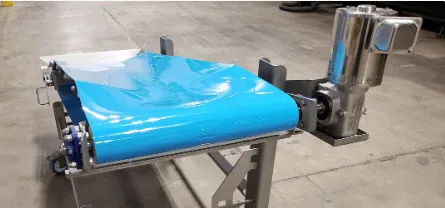
With the launch of SideDrive, One Motion now offers a drop-in DDRM replacement for conventional motor + gearbox platforms. No machine redesign. No new mounting configurations. A direct replacement that eliminates the gearbox, the guarding, the lubrication, and the base load energy penalty — all at once.
Consider what SideDrive eliminates when it replaces a conventional AC motor and gearbox assembly. A conventional system carries a base electrical load of approximately 50% of its rated power, always on, always consuming — SideDrive draws zero power until commanded to move, delivering up to 8 times less energy consumption. This is not just our claim — it is grounded in the physics documented by the U.S. Department of Energy. The DOE confirms that electric motors are designed to operate in the 50% to 100% load range, with peak efficiency near 75% of rated load, and that efficiency drops dramatically below 50% load (DOE Fact Sheet: Determining Electric Motor Load and Efficiency). In most food manufacturing environments, motors are routinely oversized for the work they actually perform — meaning they spend the majority of their operating life in the worst part of the efficiency curve, where fixed losses dominate and energy consumption no longer reflects actual mechanical work. DDRM eliminates this entirely because there is no magnetizing current required — our outer runner design uses permanent magnets to produce the magnetic field, requiring zero electrical power to sustain it. Conventional systems require lubrication, introducing oil leak risk in food-contact zones — SideDrive requires none. The complex sheet metal guarding, drip pans, and mounting hardware that every motor and gearbox demands are eliminated entirely — freeing up valuable space on and around the conveyor frame. Where a conventional drive system consumes significant volume with its motor, gearbox, guard, and drip pan footprint, SideDrive consolidates everything into a compact, self-contained unit that gives plant engineers back the space they need for other equipment, maintenance access, and sanitation. A typical AC motor in a washdown environment lasts roughly one year and carries a 1 to 2 year warranty — SideDrive is backed by a 3-year warranty and has demonstrated 6+ years of proven service life in the harshest food production environments in the industry.
This is no longer about replacing drum motors. This is about replacing the conventional motor itself.
─────────────────────────────────────────────────────
The Sustainability Case Writes Itself
The food industry is under real pressure to reduce energy consumption and carbon output. Major producers have committed to ambitious targets — 50% renewable energy, net-zero operations, measurable ESG milestones.
But here is the problem: you cannot meet those goals by optimizing a fundamentally inefficient system. You meet them by replacing the system.
When you eliminate the 50% base load penalty across hundreds of drives, running around the clock, across multiple facilities — you are not making an incremental contribution to a sustainability target. You are changing the equation entirely.
DDRM does not just support sustainability goals. It accelerates them with real engineering substance, not just a talking point on a corporate report.
─────────────────────────────────────────────────────
The Shift
For over a century, rotary motion in manufacturing has meant induction motors, gearboxes, and all the maintenance, energy waste, and complexity that comes with them.
One Motion Direct Drive Rotary Motion is a fundamentally different approach. Zero base load. Zero lubrication. Zero gearbox. Proven reliability measured in years, not months.
And now, with SideDrive, every conventional motor on every conveyor line in every plant is an opportunity.
The question is no longer whether this technology works. It does.
The question is: how fast will the industry move to adopt it?
─────────────────────────────────────────────────────
Scroll
If you made it this far, here is the article in 60 seconds:
· Conventional AC induction motors — in motor/gearbox assemblies and drum motors — burn approximately 50% of their rated power just to maintain a magnetic field, whether they are doing useful work or not. The U.S. Department of Energy confirms this inefficiency is structural, not operational.
· One Motion Direct Drive Rotary Motion has a base load of zero. It only uses the energy required to produce the commanded motion. The real-world advantage is not 50% savings — it is closer to 8 times less energy consumed.
· This technology is not theoretical. It is running 2,500 to 3,000 devices deep inside one of the largest poultry producers in the United States, with proven deployments at Blount Fine Foods, Reser’s Fine Foods, and H-E-B.
· Field life is trending 6+ years in environments where conventional motors last one year.
· With the launch of SideDrive, we are no longer limited to replacing drum motors. We can now replace every conventional motor and gearbox on the plant floor — with less space, no lubrication, no guarding, no drip pans, and a 3-year warranty.
The motor has not changed in over 100 years. We changed it.
If this matters to your operation, let’s talk.
─────────────────────────────────────────────────────
Reference
[DOE-1] U.S. Department of Energy. Determining Electric Motor Load and Efficiency. DOE Fact Sheet. https://www.energy.gov/sites/prod/files/2014/04/f15/10097517.pdf (opens in a new tab)
─────────────────────────────────────────────────────
Found this useful? Share it with your team.