Pitch, Gap Variation, and Speed Constraints in Food Packaging Systems
In food manufacturing, packaging speed is not unlimited, it’s governed by physical and process constraints. Understanding these limits is essential for designing efficient systems that balance throughput, control, and product stability.
Pitch, Gap Variation, and Speed Constraints in Food Packaging Systems
In food manufacturing, packaging speed is not unlimited; it’s governed by physical and process constraints. Understanding these limits is essential for designing efficient systems that balance throughput, control, and product stability.
Primary Packaging: The Vertical Bagging Bottleneck
Vertical baggers face hard limits:
- Gravity Drop: Product falls into the bag at gravitational acceleration.
- Sealing Time: Heat and pressure require a fixed dwell time for seal integrity.
- Result: Each bagger has a maximum speed that cannot be exceeded without compromising quality.
To increase output, manufacturers add multiple baggers in parallel, creating several product streams.
Pitch Defined
- Pitch = Leading edge to leading edge distance between consecutive products.
- Pitch Variability = Variation in that distance across the product stream.
Example for 100% pitch:
- Product length: 6”
- Gap: 6”
- Leading edge distance: Pitch Distance=6”+6”=12” {Pitch Distance} = 6” + 6” = 12”Pitch Distance=6”+6”=12”
Cycle Time
Cycle time is the time between leading edges, calculated from conveyor speed:
Cycle Time=Pitch Distance Conveyor Speed\text{Cycle Time} = \frac{\text{Pitch Distance}}{\text{Conveyor Speed}}Cycle Time=Conveyor Speed Pitch Distance
At 200 fpm (40 in/sec):
- Pitch = 12” → Cycle time = 0.30 sec
- Pitch = 18” → Cycle time = 0.45 sec
Gap Variation
- Gap = Space between the trailing edge of one product and the leading edge of the next.
- Gap Variation = How much that gap changes from one product to another in a continuous flow.
- This variation impacts:
- Pitch consistency.
- Cycle time stability.
- Control system performance for indexing and grouping.
Example
- Nominal gap: 6”
- Variation: ±1”
- Actual gap range: 5”–7”
- Leading-edge distance range: Product Length (6”) + Gap Range (5”–7”) =11”–13” {Product Length (6”)} + {Gap Range (5”–7”)} = 11”–13”Product Length (6”) + Gap Range (5”–7”) = 11”–13”
Timing Table: Gap Variation Impact at 200 fpm
Nominal Gap Variation Leading Edge Distance Range Cycle Time Range 6”±1”11” – 13”0.275 – 0.325 sec 12”±2”18” – 22”0.450 – 0.550 sec
Why Pitch and Gap Matter
- More pitch = more time between products, allowing control actions like indexing and orientation to occur reliably.
- This enables higher production rates because the system can handle products at greater conveyor speeds without losing control.
- Tradeoff: Higher speeds increase product velocity, which can cause bouncing and instability, especially for lightweight packages.
Multi-Train Collators
To manage high-speed grouping, multi-train collators use independently controlled buckets:
- Capture products quickly.
- Move filled buckets to unload zones for batch release.
- Example: At 3.3 products/sec (cycle time ~303 ms), a dual-train collator must switch buckets in ~151 ms.
Designing for Throughput
A robust system integrates:
- Parallel Baggers for volume.
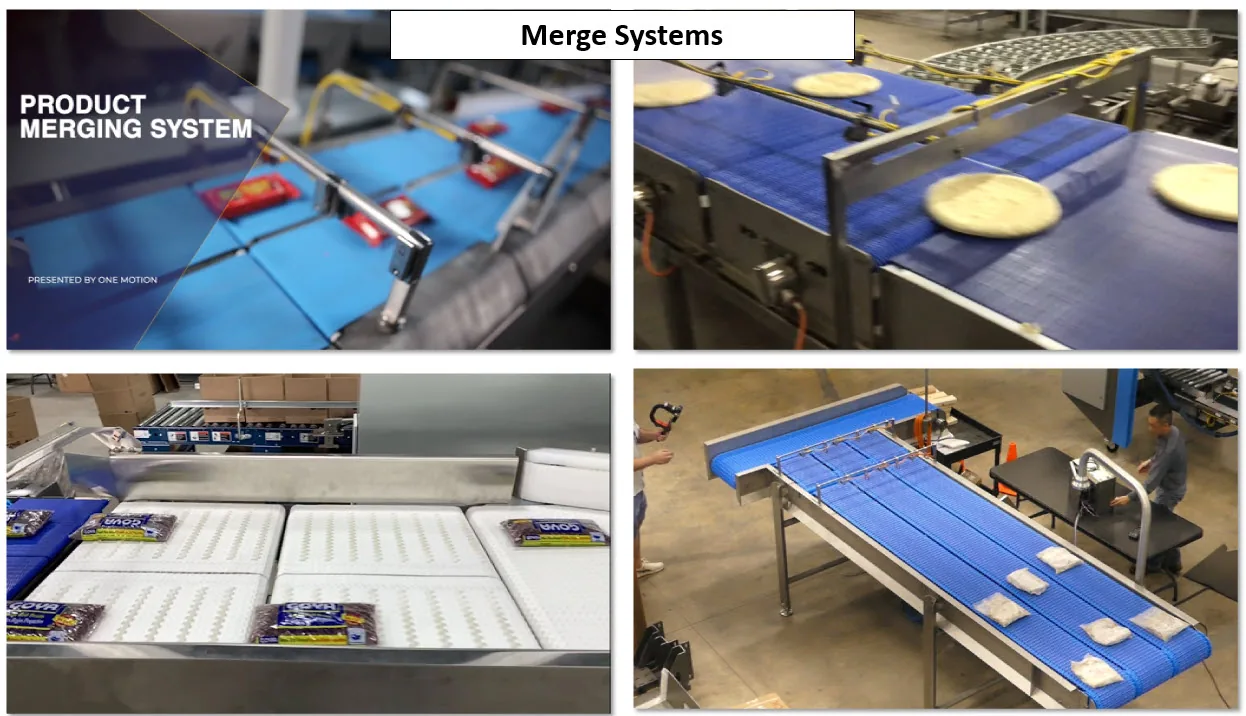
- Merging Systems for pitch control.
- Orientation Correction for alignment.
- Multi-Train Collators for grouping.
- Secondary Packaging for efficient case packing.
Bottom Line
The minimum controllable pitch and gap variation set the maximum system speed. Success depends on balancing pitch, cycle time, conveyor speed, and product stability while integrating orientation and grouping technologies.
Found this useful? Share it with your team.