DDRM - What is it?
Direct Drive Rotary Motion is the technology powering all One Motion products.
Reinventing Motion in Food & Hygienic Manufacturing: Why Direct Drive Rotary Motion Is Becoming the New Standard
The standard drivetrain in food manufacturing, AC motor, gearbox, lubrication, and mechanical seals, was borrowed from machine tools, semiconductors, and automotive. More importantly, they do not make food. Contamination from oil, grease, or mechanical wear has no food safety consequence in those environments. In food manufacturing, it does.
Food plants run high-pressure washdowns daily at 1,400 PSI with 180°F chemical foam. Gearbox seals degrade. Bearings corrode. Encoders lose accuracy. Field data consistently shows conventional motor–gearbox systems failing within one year under continuous washdown.
The problem compounds when manufacturers try to make these motors hygienic. Removing the cooling fan eliminates a harbor for bacteria and debris, but it also removes the motor’s primary method of heat dissipation. Enclosing the motor in a stainless steel housing to survive corrosive washdown chemicals traps the heat inside. The result is accelerated thermal cycling, the number one cause of motor failure in washdown environments. The motor was never designed to operate without its fan or inside a sealed enclosure. Every modification made to improve hygiene shortens its life.
Direct Drive Rotary Motion (DDRM) was not adapted from another industry. It was designed for this one.
1. What Direct Drive Rotary Motion Actually Does and What It Eliminates
DDRM delivers torque directly to the load using a permanent magnet outrunner design. The magnetic field is sustained by high-density permanent magnet arrays. The system draws energy only when producing torque. There is no magnetizing current at idle and no fixed electrical loss sustaining the magnetic field.
This architecture eliminates:
- The gearbox entirely. The electric motor is the primary failure point in a motor and gearbox solution under washdown conditions. The gearbox compounds the problem differently: it introduces food safety risk through potential oil and grease leaks, it operates within a narrow speed range forcing plants to stock multiple motor and gearbox combinations, and it robs the system of power through mechanical inefficiency in the transfer from motor to load.
- Lubrication systems. No oil, no grease, no contamination risk.
- External encoders. No exposed electronics to fail under chemical spray. DDRM provides 90% of the features of a traditional servo motor without the encoder. One Motion provides the software framework to show how to program DDRM in a servo manner, delivering servo-level control using standard VFDs.
- Mechanical transmission. No couplings, belts, or chains to maintain. The elimination of these components also reduces the physical volume of the drive system, freeing space inside the machine frame for other equipment or simplifying the overall machine footprint.
- Magnetizing current losses. The dominant fixed loss in AC induction motors, eliminated by permanent magnets. In an AC induction motor, the magnetizing current is always present regardless of load. When an oversized motor such as a 1 HP unit runs at a significantly lower load, the magnetizing current remains constant while useful output drops, causing total system efficiency to fall to as low as 10 to 20%. This efficiency collapse at partial load is documented in the U.S. Department of Energy’s Premium Efficiency Motor Selection and Application Guide (DOE/GO-102014-4107, 2014), Chapter 4, “Oversized and Underloaded Motors” and “Motor Efficiency at Full and Part Load” (pp. 4-9 through 4-14).
- The DOE guide is freely available at energy.gov (opens in a new tab). Two things worth noting:
- Chapter 2, Figure 2-4 in that same guide shows “Losses versus Motor Load for a Standard Efficiency Motor,” which visually illustrates how fixed losses (including magnetizing current) dominate at light loads. That figure alone is worth referencing if you ever put this in a slide deck. [ (opens in a new tab)energy.gov (opens in a new tab)[]](https://www.energy.gov/sites/prod/files/2014/04/f15/amo_motors_handbook_web.pdf (opens in a new tab))
- Oregon State University’s Energy Efficiency Center independently confirms the same finding with their own Motor Efficiency vs. Percent Load graph, showing efficiency plummeting below 25% load.
- The DOE guide is freely available at energy.gov (opens in a new tab). Two things worth noting:
- Oversizing penalties. DDRM delivers constant torque across its full speed range (0–500+ RPM), enabling right-sized motor selection rather than catalog-frame rounding.
The U.S. Department of Energy’s 2014 report Premium Efficiency Motor Selection and Application Guide (DOE/GO-102014-4107) documents the efficiency gains of permanent magnet motor designs over AC induction across partial-load conditions, the operating range where most food conveyors run.
In field comparisons at partial load, DDRM systems have measured approximately 8× less energy consumption than equivalent AC induction motor and gearbox combinations.
2. Three Product Families, One Motion Principle
One Motion’s product architecture is not a collection of separate products. It is a unified platform delivering DDRM across different entry points.
MagDrive — Engineered OEM Platforms
Custom torque, geometry, and performance for equipment manufacturers designing new machines around DDRM. Applications already in service include automatic feeding systems, product merging, film registration, bag collation, and hygienic conveying. MagDrive is how OEMs eliminate gearboxes at the design stage.
SideDrive — Drop-In Motor + Gearbox Replacement
A 316L stainless steel, IP69K-rated direct drive module with a standard NEMA 56C bolt pattern. SideDrive mounts where the old motor and gearbox sat. No machine redesign. Operates 0–100 Hz. Replaces both AC motor/gearbox assemblies and servo motor/gearhead combinations in washdown environments. Deployed in facilities including Tyson and HEB.
PulleyDrive — Drum Motor Replacement
A gearless, oil-free motor fully contained inside the conveyor pulley. Available in 58–215 mm sizes. Unlike conventional drum motors — which still contain gears and oil internally — PulleyDrive eliminates those failure modes entirely while maintaining the clean form factor that washdown zones require.
Sales Adoption Path
SideDrive gets DDRM into the plant. PulleyDrive captures the conveyor. MultiDrive scales to system-level control. MagDrive defines the next machine architecture.
3. Validation: 20,000+ Units Produced, 5+ Year Field MTBF
Since 2014, One Motion has produced over 20,000 DDRM units. More than 1,000 installations are operating globally, principally in North America, across poultry, dairy, beef, and other hygienic and sanitary washdown environments.
These are not projections. Field performance tracking across these installations shows an average mean time between failures (MTBF) of approximately five years in heavy washdown conditions, compared to one to two year service life for conventional motor and gearbox systems. One Motion backs this with a three-year performance warranty, versus the industry-typical one year.
SideDrive operated inside customer facilities for more than six years before it was released as an external product. During that period, One Motion validated torque stability, long-term duty cycle behavior, sanitation survival, and mechanical simplicity under real production conditions.
5. Total Cost of Ownership: What Actually Gets Eliminated
DDRM does not reduce drivetrain costs incrementally. It removes entire cost categories.
Eliminated entirely:
- Gearbox rebuilds and spare gearbox inventory
- Lubrication systems, oil, and grease
- Oil contamination risk and associated sanitation labor
- Encoder replacement and alignment procedures
- Belt and coupling maintenance
Reduced significantly:
- System heat (no gearbox friction losses)
- Electrical complexity. SideDrive operates with standard PowerFlex 525 VFDs. No servo drives or encoders required in open-loop applications.
- Energy consumption (up to 8x reduction vs. AC induction)
- Component wear and unplanned downtime
The financial model shifts from recurring replacement spend to a longer-life, lower-touch asset. At scale, One Motion compresses the replacement-driven portion of market demand, similar to how LED lighting reduced bulb replacement frequency or solid-state drives displaced mechanical hard drives.
6. Where DDRM Is Already Running
This is not a concept. DDRM is operating across food manufacturing today.
Conveying
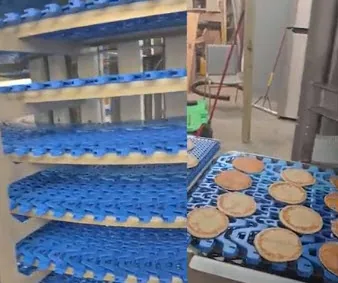
Straight, curved, incline, Z-type, horizontal motion, multi-belt feeders, chain conveyors
Processing
Meat skinning, positive displacement pumps, cheese mixing
Packaging
Timing, metering, grouping, merging, film registration, bag collation
Emerging
Blending, mixing, pumping
Each application shares the same requirements: continuous motion, harsh operating environment, daily sanitation, and reliability over precision.
7. What This Means for Your Operation
If your plant runs daily washdowns and your motor–gearbox systems fail every one to two years, the math is straightforward. DDRM extends service life by 3–5× while eliminating the components that cause most failures.
Found this useful? Share it with your team.